July 11, 2025
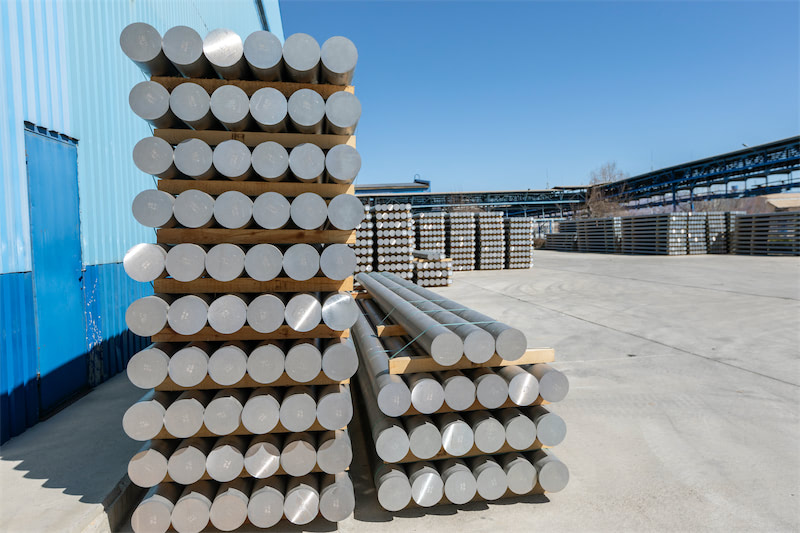
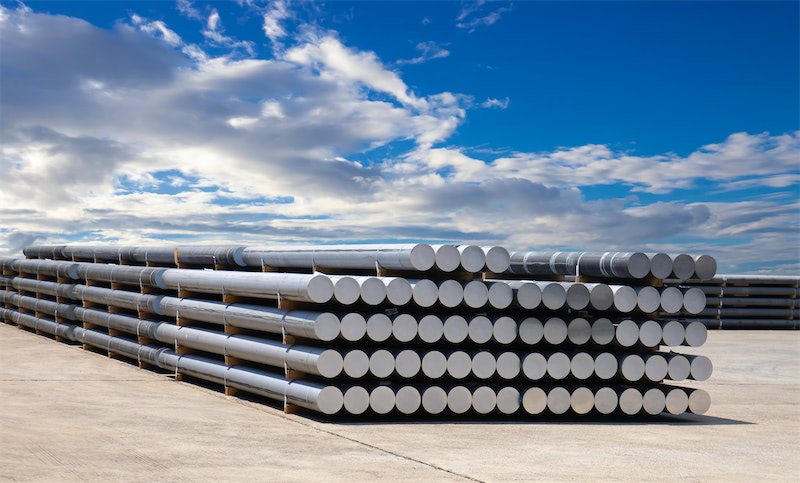
According to SMM's latest monthly data survey, the total production of aluminum rods nationwide in June 2025 was 390,000 mt, a decrease of 27,000 mt from May. After adjusting for the number of days in the month, the operating rate of aluminum rod plants in June was recorded at 60%, down 2% MoM and up 5% YoY. Overall, despite weak downstream purchasing, in-plant inventory was in the initial stage of buildup, coupled with the task of liquid aluminum alloying, the aluminum rod supply side remained at highs in June. However, as the off-season atmosphere in the downstream sector became increasingly pronounced, market purchasing weakened significantly. In mid-to-late June, many plants reported production cuts and equipment maintenance, expecting a pullback in the aluminum rod supply side in July, with the pressure of supply surplus in the market potentially easing slightly.
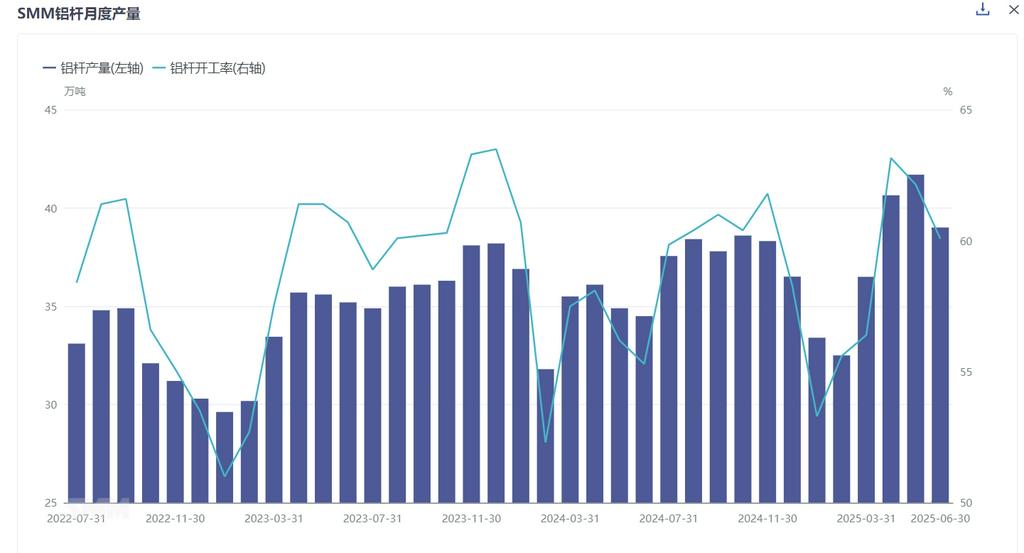
In terms of operating rates by region, all provinces showed a trend of declining operating rates. As a major production hub for aluminum rods, Shandong and Inner Mongolia recorded operating rates of 82.7% and 75.2%, respectively, with a slight MoM decline. Meanwhile, provinces such as Guangxi, Guizhou, Ningxia, and Qinghai also showed a downward trend in operating rates. By early-to-mid July, many aluminum rod plants reported increasing inventory pressure, coupled with the sustained high aluminum prices suppressing consumption. Plants were about to enter the production cut and maintenance phase, so it was expected that operating rates in various provinces would still face downward pressure in July.
According to SMM, the in-plant inventory of aluminum rod plants accumulated for 9.2 days, an increase of 6.04 days MoM. In-plant inventory of aluminum rod plants showed an upward trend within the month due to weak downstream consumption. However, with many production cut expectations emerging from the supply side in July, the subsequent increase in supply may slow down, and it was expected that in-plant inventory of aluminum rod plants would operate within the range of 6-13 days in July.
In terms of specific processing fees, the average monthly ex-factory processing fee for 1A60 in Shandong in June was recorded at 310 yuan/mt, a decrease of 221 yuan/mt MoM. The average monthly ex-factory processing fee in Henan was recorded at 355 yuan/mt, a decrease of 160 yuan/mt MoM. The average monthly ex-factory processing fee in Inner Mongolia was 212 yuan/mt, down 237.5 yuan/mt MoM. In the three major trading hubs, the average monthly delivered processing fee in Hebei was 302 yuan/mt, down 281 yuan/mt. The average monthly delivered processing fee in Jiangsu was 382 yuan/mt, down 301 yuan/mt. The average monthly delivered processing fee in Guangdong was 302.5 yuan/mt, down 281 yuan/mt. It was expected that processing fees in various regions would still face downward pressure in July, mainly due to the relative supply surplus in the market and weak demand. The upside potential for aluminum rod processing fees was relatively limited, with low trading sentiment in the industry and difficulty in lifting the center of processing fees in the short term.
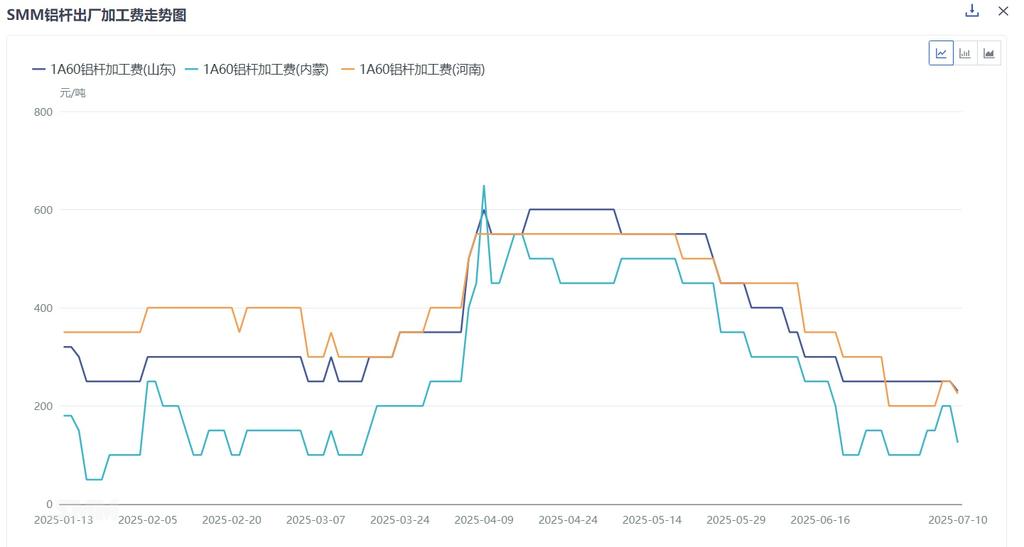
SMM believes that the performance of the aluminum rod market in June was not ideal. Due to the sustained high operating rates of aluminum rod plants, in-plant inventory continued to accumulate. However, the sustained high aluminum prices suppressed downstream consumption, coupled with the off-season cloud hanging over the industry. Weak demand led to a relative supply surplus in the market, and processing fees struggled to improve. Therefore, considering the increasing trend of in-plant inventory and the off-season demand, it is expected that the processing fees of aluminum rods will continue to operate at a low level in the short term. From a medium and long-term perspective, downstream wire and cable enterprises are not short of backlog orders, and there will still be a concentrated delivery phase in H2, with rigid demand still able to support industry consumption. Despite the expectation of concentrated deliveries for downstream aluminum wire and cable, considering the accumulation of in-plant inventory, there may be a certain lag in the rebound cycle of aluminum rod processing fees.